



Identification markings
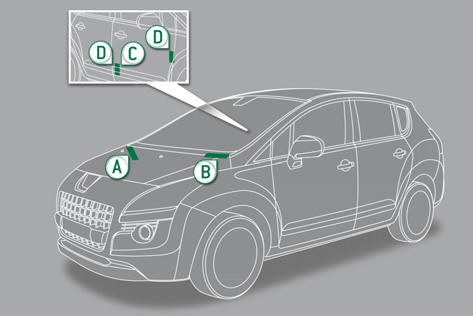
Various visible markings for the identifi - cation and tracing of your vehicle.
A. Vehicle identification Number (VIN) under the bonnet.
This number is engraved on the bodywork near the damper support.
B. Vehicle identification Number (VIN) on the windscreen lower crossmember.
This number is indicated on a selfadhesive label which is visible through the windscreen.
C. Manufacturer's label.
The VIN is indicated on a self-destroying label affixed to the door aperture, on the driver's side.
D. Tyre/paint label.
This label is fitted to the middle pillar, on the driver's side.
It bears the following information:
- the tyre infl ation pressures with and without load,
- the tyre sizes,
- the brands of tyre recommended by the manufacturer,
- the infl ation pressure of the spare wheel,
- the paint colour code.
 The tyre pressures must be checked when the tyres are cold, at least once
a month.
The tyre pressures must be checked when the tyres are cold, at least once
a month.

Low tyre pressures increase fuel consumption.