



Installing child seats attached using the seat belt
In accordance with European regulations, this table indicates the options for installing child seats secured using a seat belt and universally approved (a) in accordance with the weight of the child and the seat in the vehicle.
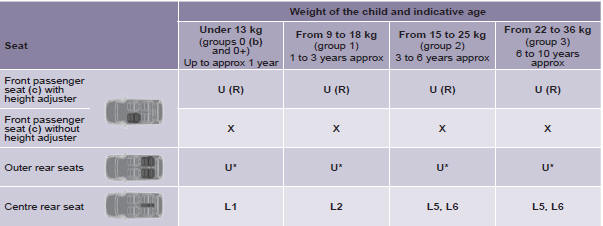
a: universal child seat, child seat that can be installed in all vehicles using a seat belt.
b: group 0, from birth to 10 kg. Shell seats and baby carriers cannot be installed in the front passenger seat.
c: consult the legislation in force in your country before installing your child on this seat.
U: seat suitable for the installation of a child seat secured using a seat belt and universally approved, "rearwards-facing" and/or "forwards-facing".
U (R): as for U , with the vehicle's seat adjusted to the highest position and as far back as possible.
L-: only the child seats indicated can be installed on the seat concerned (according to country).
X: seat position not suitable for installation of a child seat for the weight class indicated.
In accordance with European regulations, this table indicates the options for installing child seats secured using a seat belt and universally approved (a) in accordance with the weight of the child and the seat in the vehicle.
* Child seats with a stay (or drop down leg) should be fitted to your vehicle with care. See "Fitting a child seat with a stay" for more information.
See also:
e-HDi micro-hybrid technology
After the 508, the new Peugeot 308 is the second of the Marque's cars to
introduce the innovative e-HDi micro-hybrid technology, a new generation STOP &
START.
This innovation is based on th ...
Child seat in the front
"Rearwards-facing"
When a "rearwards-facing" child seat is installed on the front passenger seat
, it is essential that the passenger airbag is deactivated. Otherwise, the child ...
5-speed manual gearbox
Engaging reverse gear
Push the gear lever to the right then backwards.
Only engage reverse gear when the vehicle is stationary with the engine at idle.
As a safety precaution and to facilitate st ...