



Towing the vehicle
Procedure for having your vehicle towed or for towing another vehicle using a removable towing eye.
Access to the tools
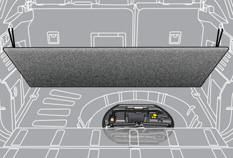
The towing eye is installed in the boot under the floor.
To gain access to it:
open the boot,
raise the floor,
secure it by hooking the cords on the hooks on the rear parcel shelf support,
remove the polystyrene box,
remove the towing eye from the holder.
Towing from the front
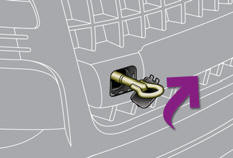
On the front bumper, unclip the cover by pressing at the bottom.
Screw the towing eye in fully.
Install the towing bar.
Switch on the hazard warning lamps on the towed vehicle.
 Place the gear lever in neutral (position N on the electronic gear control
gearbox or automatic gearbox).
Failure to observe this special condition could result in damage to certain braking
components and the absence of braking assistance the next time the engine is started.
Towing from the rear
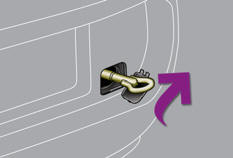
On the rear bumper, unclip the cover by pressing at the bottom.
Screw the towing eye in fully.
Install the towing bar.
Switch on the hazard warning lamps on the towed vehicle.
General recommendations
Observe the legislation in force in your country.
Ensure that the weight of the towing vehicle is higher than that of the towed vehicle.
The person at the wheel of the towed vehicle must have a valid driving licence.
When towing a vehicle with all four wheels on the ground, always use an approved towing bar; rope and straps are prohibited.
When towing a vehicle with the engine off, there is no longer any power assistance for braking or steering.
In the following cases, you must always call on a professional recovery service:
- vehicle broken down on a motorway or fast road,
- 4 wheel drive vehicle,
- when it is not possible to put the gearbox into neutral, unlock the steering,
or release the parking brake,
- towing with only two wheels on the ground,
- where there is no approved towing bar available...
See also:
A few definitions
Range (miles or km)
This indicates the distance which can still be travelled with the fuel remaining
in the tank in relation to the average fuel consumption over the last few miles
(kilometres) ...
Forwards-backwards
Raise the control and slide the seat forwards or backwards. ...
Moving off
Select position N.
Press the brake pedal down fully.
Start the engine.
N appears in the instrument panel
screen.
N flashes in the instrument panel, accompanied by an audible signal and a ...