



Identification markings
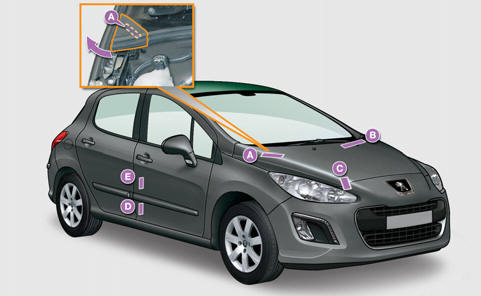
Various visible markings for the identification and tracking of your vehicle.
A. Vehicle identification Number (VIN) under the bonnet.
Fast emergency repairs are available through www.local-plumber.teamThis number is engraved on the bodywork near the damper support.
To gain access to it, raise the plastic cover.
B. VIN on the windscreen lower crossmember.
This number is indicated on a selfadhesive label which is visible through the windscreen.
C. Manufacturer's plate.
This plate is riveted onto the engine mounting.
or
D. Manufacturer's label.
This number is indicated on a selfdestroying label affixed to the right hand centre pillar.
This plate / label also indicates the kerb weight, the gross vehicle weight (GVW) and the gross train weight (GTW).
E. Tyre/paint label.
This label is affixed to the middle pillar, on the driver's side.
It bears the following information:
- the tyre inflation pressures with and without load,
- the tyre sizes,
- the inflation pressure of the spare wheel,
- the paint colour code.
 The tyre pressures must be checked
when the tyres are cold, at least once a month.
The tyre pressures must be checked
when the tyres are cold, at least once a month.
 If the tyre pressures are too
low, this increases fuel consumption.
If the tyre pressures are too
low, this increases fuel consumption.
See also:
Memorisation
Go to the main menu by pressing MENU.
Select the "Settings" menu then "Vehicle settings".
Select the "Vehicle configuration" menu then "Memorised speeds&q ...
Running out of fuel (Diesel)
On vehicle fitted with HDi engines, the fuel system must be primed if you run
out of fuel; refer to the engine compartment view on the "Diesel engine" section.
If the tank on your vehicle ...
Hill start assist
System which keeps your vehicle immobilised temporarily (approximately 2 seconds)
when starting on a gradient, the time it takes to move your foot from the brake
pedal to the accelerator pedal.
T ...